Event
Event
In software development, an event is an action or occurrence that happens in a program, to which the program might respond.
- These events are often generated by the user’s interaction with the application, but they can also be triggered by the system itself.
- Common Examples of Events:
- A user clicking a button.
- A user pressing a key on the keyboard.
- A web page finishing its loading process.
- A window being resized.
- Receiving data from a server.
- Think of an event as a signal that something has happened.
Event Listener
Event
An event listener (also known as an event handler) is a function that “listens” for a specific event to occur on a specific element.
- When the event happens, the listener is “triggered,” and the code inside the function is executed.
@EventListenerAnnotation- marks a method as an event listener
- When you start your application, Spring scans for all methods marked with
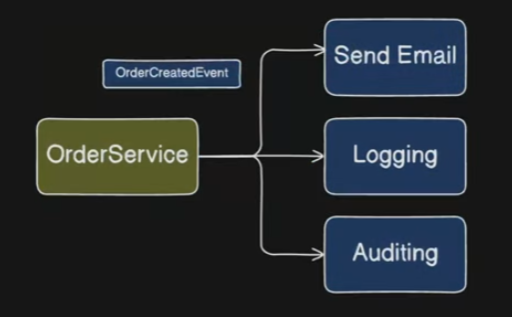
@EventListener. WheneventPublisher.publishEvent()is called, Spring checks the type of event being published (in our case,UserCreatedEvent). It then finds the matching listener method (sendWelcomeEmail) and executes it, passing the event object as an argument - creates a loosely coupled system ⇒ The
UserServicehas no idea that anEmailServiceeven exists
Sample diagram
Example
A common use case is sending a welcome email after a new user registers.
UserCreatedEvent
- First, we define the event itself. This is a simple class that holds the data related to the event, like the new user’s email.
// This class represents the "what happened" signal.
public class UserCreatedEvent {
    private final String userEmail;

    public UserCreatedEvent(String userEmail) {
        this.userEmail = userEmail;
    }

    public String getUserEmail() {
        return userEmail;
    }
}
UserService
- The publisher is the component that creates and sends out the event. Here, a
UserServicepublishes aUserCreatedEventafter creating a new user.
import org.springframework.context.ApplicationEventPublisher;
import org.springframework.stereotype.Service;

@Service
public class UserService {

    // Spring injects an event publisher for us.
    private final ApplicationEventPublisher eventPublisher;

    public UserService(ApplicationEventPublisher eventPublisher) {
        this.eventPublisher = eventPublisher;
    }

    public void createUser(String email, String password) {
        // ... logic to save the user to the database ...
        System.out.println("User created with email: " + email);

        // Announce that a new user has been created.
        UserCreatedEvent event = new UserCreatedEvent(email);
        eventPublisher.publishEvent(event);
    }
}
EmailService
- The listener waits for the event. The
EmailServiceisn’t called directly by theUserService. Instead, it just listens for theUserCreatedEvent.
import org.springframework.context.event.EventListener;
import org.springframework.stereotype.Service;

@Service
public class EmailService {

    // This method will automatically be called when a UserCreatedEvent is published.
    @EventListener(UserCreatedEvent.class)
    public void sendWelcomeEmail(UserCreatedEvent event) {
        System.out.println("Sending welcome email to: " + event.getUserEmail());
        // ... logic to actually send the email ...
    }
}