Main
- Library = Like reusable Tetris blocks — you choose when and how to use them
- Framework = Like a Tetris board with cutouts — you must fit the blocks into the given structure
Example
| Language | Library | Framework |
|---|---|---|
| Python | Pandas, Numpy | Django, Flask |
| JavaScript | Axios | React, next.js |
| ☕Java | Apache Commons | Spring Framework, Collections Framework |
| C# | Math.NET | Unity |
- When choosing a framework/library to learn, you need to choose carefully what you will learn because you will most likely take lots of time into learning
Library
- Libraries are usually specific to certain programming languages (Python - Pandas)
- You bring code that you want (which someone else wrote) and add it to your project
- Use when you need to add specific functionality
Framework
Framework in programming generally provides a specific mold or structure for programming
- Use when you want to build structured application with less boilerplate
- Advantage
- It includes features that I might not have thought of
- Reduces development time.
- Standardized nature allows for an expected level of quality.
- Easier maintenance.
- Disadvantages
- over-reliance can diminish a dev’s abilities
- learning curve per framework
- Basically
- Programmers initially wrote each application from scratch using a specific programming language, but as more applications were made it was easier to observe that many of these apps had similar requirements, such as:
- Logging error, warning, and info messages
- Transactions
- Protection mechanisms against the same common vulnerabilities
- Mechanisms for performance increase, like caching or data compression
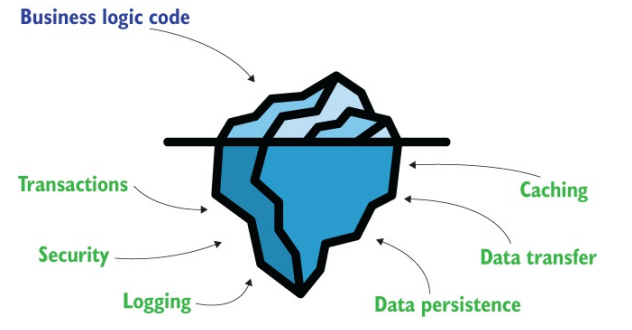
- It turned out that the business logic code implemented in an app is significantly smaller than the stuff that makes the engine of the application!
- Programmers initially wrote each application from scratch using a specific programming language, but as more applications were made it was easier to observe that many of these apps had similar requirements, such as:
In an app (containing business logic code)
- Business logic code
- Code that implements the business requirements of the application, it’s what implements the user’s expectations in an application
- Ex) “clicking on a specific link will generate an invoice”
- Business logic code is what makes an app different from another
- But an app has much more features
- The user’s perspective is similar to viewing an iceberg! ⇒ they observe the results of the business logic code, but it’s only a small part
- Various applications can just reuse the other features (caching, data transfer, etc)
- diagram
Types of Frameworks
| Category | Description | Examples |
|---|---|---|
| Persistence Framework | Frameworks that provide classes and configuration files as libraries for handling data storage, retrieval, modification, and deletion. | - Mybatis- Hibernate |
| Java Framework | Frameworks that modularize and provide necessary elements, focusing on web application development through Java EE. | - Spring Framework - Struts |
| UI Implementation Framework | Frameworks that provide a structure to facilitate easier front-end implementation. | - Bootstrap - Foundation - MDL |
| Function & Support Framework | Frameworks that offer features to assist with specific functionalities or task execution. | - Log4j - JUnit - ANT |