Class
Class
A unit of code that is the basic building block of Java programs.
- In Java, nothing can exist outside of a class. A Java program is stored in a class.
- Convention: starts with capital letter, and class & file name must match
public class <name> { ... }
- Class header
- The first line in a class, like
public class <name> {
- The first line in a class, like
- Two types of members in a class:
- Fields
- Methods
- A program unit that represents a particular action or computation.
- The next-smallest unit of code in Java after classes
- The first line of a method = method header
- For getter and setter, you can use the
Generatefunction in Intellij
class Person
{
    String name;     // field
    void greet() {   // method
        System.out.println("Hello, World!");
    }
}
Main method
- At a minimum, a complete program requires a special method named
main. <statement>= An executable snippet of code that represents a complete command.System.out.println("Hello, world!")is aprintlnstatement- They are executed in order
public static void main(String[] args) {
	<statement>; // series of actions
	<statement>;
	...
	<statement>;
}
Object class
- By default, every class extends an
Objectclass- Every time you try to print an object, it will call the
toString()method of the object
- Every time you try to print an object, it will call the
Person p = new Person(); // creating a new instance| Component | 구성 요소 | Description / 설명 |
|---|---|---|
| Field | 필드 | - Attributes or properties an object has (e.g., name, age, etc.) - 객체가 가지는 속성 (예: 이름, 나이 등) |
| Method | 메서드 | - Actions or behaviors the object can perform - 객체가 수행할 수 있는 동작 |
| Constructor | 생성자 | - A special method called when the object is created - 체 생성 시 호출되는 특수한 메서드 |
| Inner Class | 이너 클래스 | - A class defined inside another class, used when needed - 클래스 내부에 정의된 또 다른 클래스 (필요 시 사용) |
🧠 Fields and methods represent the state and behavior of an object.
- state → represented by fields
- the data an object holds
- behavior → represented by methods
- the actions an objects can perform
Fields
- Variables that exist to hold the data the instance will have, and they represent attributes
- Class and instance variables are both fields
- Class vs Instance variables
- related: Local VS Class VS Instance variables
Methods
- What’s in a method
- Method signature: method name + parameters
addInt(int num1, num2)- A good method signature lets you know what the function does & returns at first glance
- Method body
- Method signature: method name + parameters
- class methods
- method overloading
Variadic Arguments; varargs
- Allows a method to accept zero or more arguments of a specified type — like passing an array without needing to create one manually
- without this, we’ll have to overloading
ntimes
public void printNames(String... names) {
    for (String name : names) {
        System.out.println(name);
    }
}

printNames(); // zero arguments
printNames("Alice");
printNames("Bob", "Charlie", "Dave");- Conditions
- Only one varargs parameter is allowed per method
- It must be the last parameter in the parameter list
- Internally
- Java converts to array
Instance
Instance
An instance is a real instance of a class.
- It has its own data stored in the attributes.
- You can call methods on the object to perform actions or change its state
- All instances are objects
Person p1 = new Person();- p1 is a reference variable, which stores the address of the heap that has the data
- You “instantiate” with the
newkeywordnew쓰는 건 생성자를 호출하는 것new⇒ you’re putting the object in the heap memory and putting its address in the reference variable
- Image overview
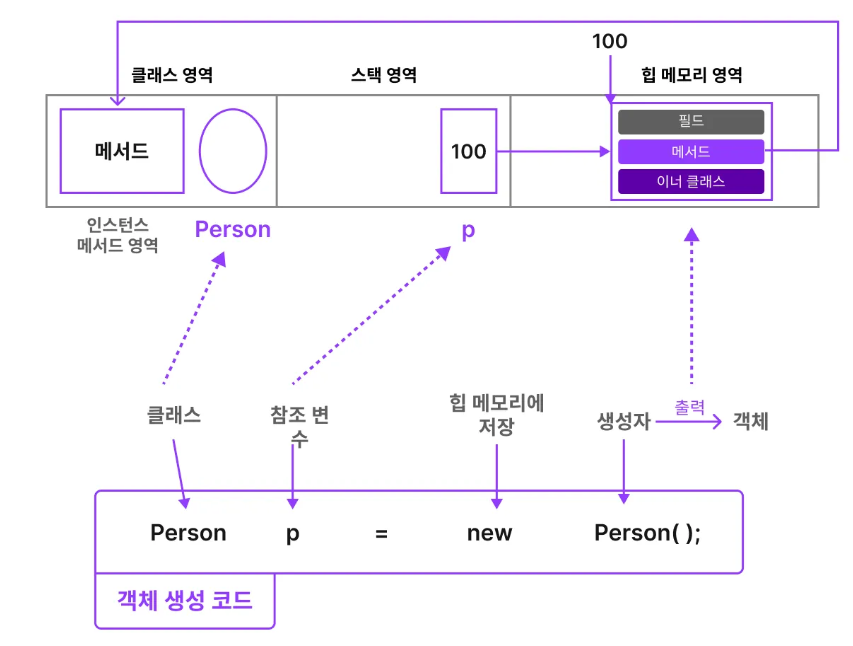
- 즉 같은 클래스로 만든 모든 객체는 동일한 메서드 값을 공유하기 때문에 여러 번 같은 메서드를 선언해 주는 것이 아니라 한 번만 저장해 두고 필요한 경우에만 클래스 영역에 정의된 메서드를 찾아 사용할 수 있는 것입니다.
- All instances of the same class share the same methods
- they all reuse the same method stored in the class area