Overview
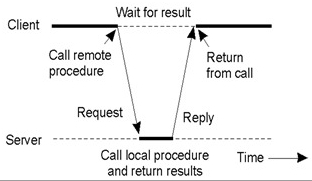
A request from a client to execute a function on a server
- When a computer program causes a procedure to execute in a different address space (perhaps on another computer) → location independent
- To the client, looks like a procedure call
- To the server, looks like an implementation of a procedure call
- Diagram
(Review) Local procedure call
- The caller and the callee are both in the same program (in same)
- Caller invokes function (by name) with arguments
- Pass some arguments in registers, push others
- Push return program counter
- jump to first instruction in callee
- Callee (implementation of function)
- Reads parameters from registers and stack
- Computes function, possibly updates state, returns result
- Jumps back to next instruction in caller
- Example
- Caller:
if (BuyBook(OSPP)) print(“Done!”); - Callee:
Boolean BuyBook(char \*booktitle) { do stuff; return success; } - With an RPC, the
BuyBookfunction would be running on a completely different computer
- Caller:
- Compiler defines protocol: name binding, where to find arguments, etc.
Remote procedure call (RPC)
- Client request to execute a function on the server
- The goal is to hide the network communication from the developer.
- The developer just writes
result = BuyBook(OSPP), and the RPC framework handles all the complex network steps in the background.
- The developer just writes
- The goal is to hide the network communication from the developer.
- On client:
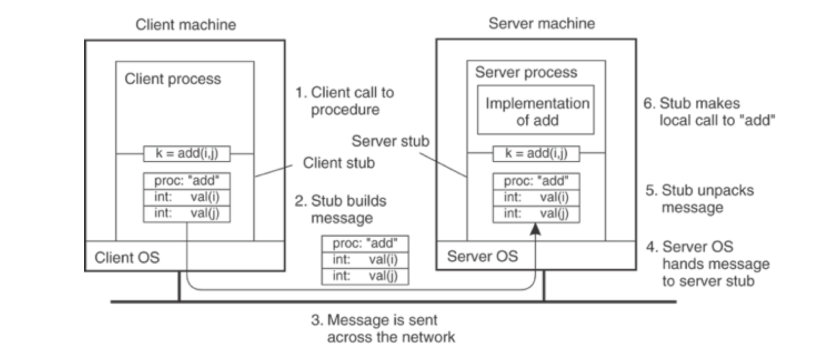
result = BuyBook(OSPP)- Parameters marshalled into a message (arbitrary types)
- Marshalling (also called “serializing”) = the process of taking the parameters (in this case,
OSPP) and converting them into a standardized byte format that can be sent in a network message
- Marshalling (also called “serializing”) = the process of taking the parameters (in this case,
- Message sent to server (may be multiple pkts)
- The byte stream (the “message”) is broken down into network packets and sent over the network (TCP/IP) to the server’s address
- Wait for reply
- Parameters marshalled into a message (arbitrary types)
- On server: implement
BuyBook- The server has the actualBuyBookfunction code, it is listening for incoming network requests- message is parsed
- Parsing (also called “unmarshalling” or “deserializing”) = the process of receiving the stream of bytes from the network and converting it back into the original data structures the function understands (e.g., the string
"OSPP").
- Parsing (also called “unmarshalling” or “deserializing”) = the process of receiving the stream of bytes from the network and converting it back into the original data structures the function understands (e.g., the string
- Perform operation (executes local
BuyBook("OSPP")) & gets result - Put result into a message (may be multiple pkts)
- Result returned to client
- message is parsed
- The client (which was waiting) receives the message, parses (unmarshalls) the result, and its original function call
result = BuyBook(OSPP)completes
Why Serialize?
- Procedure arguments can be values or pointers
- Need to be assembled into a linear message
- What should happen if you call an RPC with a pointer?
- Pass the pointer? Convert it to a global reference?
- The RPC framework (the “stub” code that is auto-generated) detects that the argument is a pointer and follows one of two strategies, depending on how the pointer is being used.
- File write - Pass a copy of the data it points to
- Most common solution
- Dereferences the pointer (follows it to the actual data), serializes (copies) that data, and puts the copy of the data into the network message
- File read -Store the result
Implementation
RPC vs Procedure Call
Problems RPCs have that LPC (local procedural calls) don’t have
- Binding
- Client needs a connection to server
- Server must implement the required function
- What if the server is running a different version? (ex, function accepts different parameters)
- Service Discovery Service
- Solution to binding problem
- Like a phonebook - Includes what services are available, including versions and packet formats (may be 1000s of APIs)
- When server starts it registers itself here, when client makes a call it asks this service
- Interface Description Language (IDL)
- An IDL (like Google’s Protobuf) is a file that acts as a language-neutral contract. You define the functions and, most importantly, the exact structure of the data.
- automatically writes all the complex serialization/deserialization code for you, programmer just uses the generated classes
- Failures
- What happens if messages get dropped? Duplicated? Delayed? Reordered?
- What if client crashes?
- What if server crashes?
- What if server crashes after performing op but before replying?
- What if server appears to crash but is slow?
- What if network partitions?
- (461 alert) Some are handled by TCP but what if TCP socket fails?
- The Naive RPC is a simple implementation that is vulnerable to almost all failure listed above
Naive RPC
- The most basic implementation you could ever build (problematic)
- Nodes
- Any number of clients and servers
- No state at client or server
- Server performs operation if it gets a message
- Messages
- Client requests, server replies
- Client request contains IP address of client/server, name of procedure, arguments
- Server reply contains IP address of server/client, results
- Timers: none
What can go wrong?
- Message corruption
- Delivered msg might be different: Becomes “buy Silberschatz” instead of “buy OSPP”
- 📌Fix: include checksum or CRC or cryptographic signature in each message
- Message dropped
- Request message dropped (due to failure)
- operation not performed, client waits forever
- Reply message dropped
- operation was performed, but client doesn’t know if operation was performed, waits forever
- 📌Fix with client timer and retransmit
- Request message dropped (due to failure)
- Request message duplicated
- operation performed twice
- If multiple requests, and some are dropped
- client doesn’t know which operation was done and which ones aren’t
- 📌Fix: use unique ID per request: (client ID, sequence number)
- Message ordering
- Network congestion
- Client sends sequence of msgs to server (
a,b,c,d..) (using threads) but some can get dropped (network congestion) - If it’s a sequence for CRUD (delete, create, then fill new file), if the sequence is mixed then it can’t do it properly
- Client sends sequence of msgs to server (
- Network reorders packets, server gets different sequence
- 📌Fix: Label messages with sequence number
{seq: 1, op: "delete"}- Detect missing messages & unneeded retransmissions
- Labs assume each client sends only one RPC at a time
- If client sends the next RPC, it means they must have received the reply for the previous one
- Still need to worry about lost and duplicate and delayed RPCs
- E.g., server might get a delayed request
- Network congestion
RPC Semantics
- Semantics = meaning
- How many times will an RPC be executed by the server before it returns to the invoker of the RPC?
- At least once (NFS, DNS)
- Client retries
- If reply: executed at least once
- If no reply: maybe executed, maybe multiple times
- At most once
- • If reply: executed once
- If no reply: maybe executed, but never more than once
- Server prevents non-unique requests from compound
- UID (sequence numbers like 1,2,3,4)
- [Don’t use UUID.randomUUID]
- Idempotent
- Exactly once
- If reply: executed once
- If no reply: keep waiting
- At most once with retries