Overview
Transaction propagation is a setting that determines whether a sub-method will use a new transaction or participate in an existing one when a transaction is already in progress.
- In Spring, it’s configured via the
propagationattribute of@Transactional, withREQUIREDas the default.- Declarative vs. Programmatic Transaction - Declarative Transaction (@Transactional)
- Transaction propagation settings are important for the following reasons:
- Maintaining the consistency of business logic
- Controlling the scope of rollbacks when exceptions occur
- Optimizing performance
- Controlling concurrency
Managing Multiple Operations as One Transaction
Before (independent)
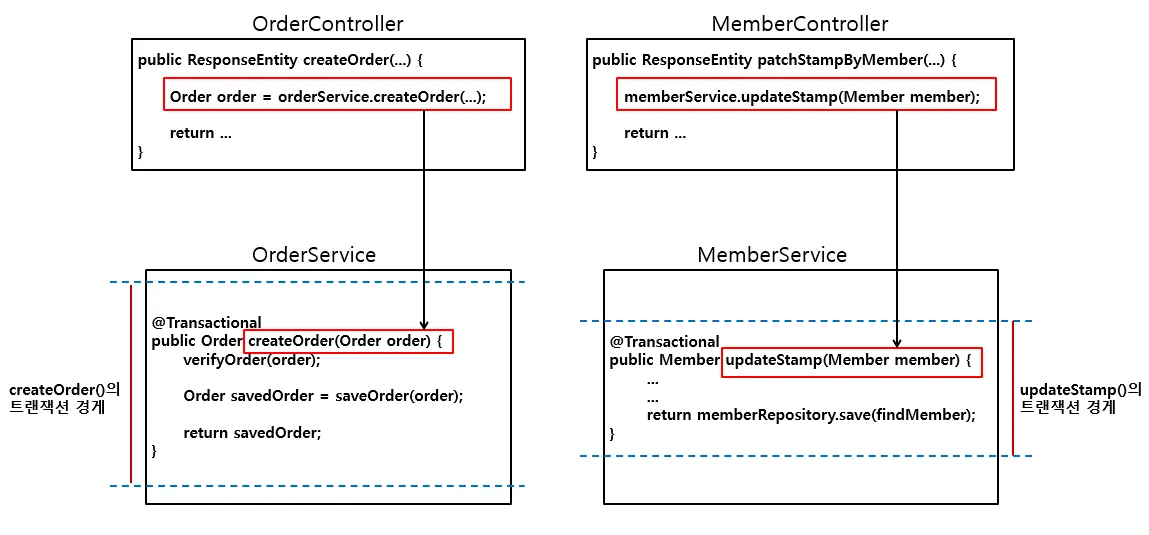
orderService.createOrder()→ saves order infomemberService.updateStamp()→ update stamp- If these two transactions are executed independently like this
- if an exception happens during the
updateStamp()operation: the order information will be saved, but the stamp count will not be updated.
- if an exception happens during the
After (single transaction)
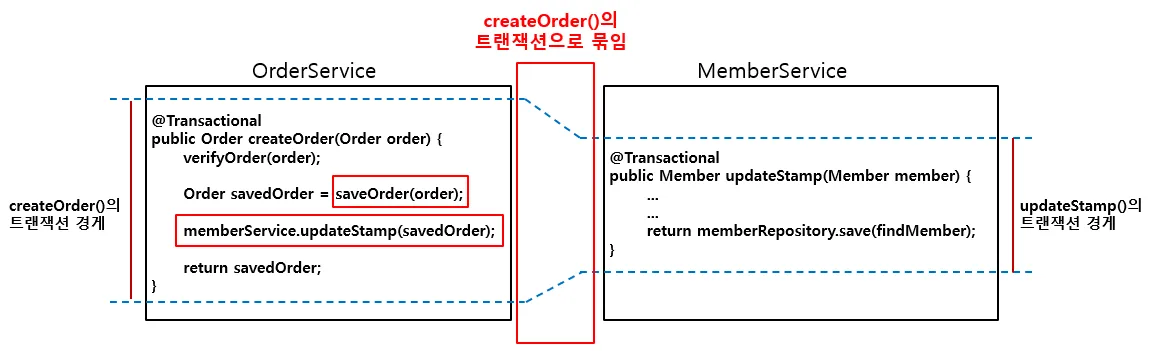
- Now, if an exception occurs while processing
memberService.updateStamp(), all operations in both classes will be rolled back since they are within the same transaction boundary - In the diagram you can see that the individual transaction boundaries are now connected into one
Example Code
OrderService
@Transactional  // (1)
@Service
public class OrderService {
    ...

    public Order createOrder(Order order) {
        verifyOrder(order);
        Order savedOrder = saveOrder(order);
        updateStamp(savedOrder); // <<<<<

		// (2)
        throw new RuntimeException("rollback test");
//        return savedOrder;
    }

    private void updateStamp(Order order) { // <<<<
        Member member = memberService.findMember(order.getMember().getMemberId()); // 3
		...

        memberService.updateMember(member); // 4
    }

    private Order saveOrder(Order order) {
        return orderRepository.save(order);
    }
	...
}@Transactionalon the class →@Transactionalapplied to all public methods likecreateOrder()- we throw new error for testing
- We call
memberService.findMember(has@Transactional) - We call
memberService.updateMember(has@Transactional)
MemberService
@Transactional
@Service
public class MemberService {
    ...

     // (1)
    @Transactional(propagation = Propagation.REQUIRED)
    public Member updateMember(Member member) {
        Member findMember = findVerifiedMember(member.getMemberId());

		...
        return memberRepository.save(findMember);
    }

    @Transactional(readOnly = true)
    public Member findMember(long memberId) {
        return findVerifiedMember(memberId);
    }

	...
}
updateMember(Member member)- has
propagation = Propagation.REQUIRED - this ensures that if a transaction is alr in progress when the method is executed, the method will use that existing transaction (if none exists a new one will be created)
- So, when
createOrder()fromOrderServiceis called, a new transaction is created → then whenudpateMember()is called from within thecreateOrder()method, it participates in this alr existing transaction
- has
- If you test
postOrderto the controller, the exception has occurred- both
saveOrderandupdateStamp(which contains calls tomemberRepository) are rolled back
- both
Transaction propagation options
| Option | Description | Use Case / Example |
|---|---|---|
REQUIRED | Joins an existing transaction, creates a new one if none exists. | Most standard business logic. |
REQUIRES_NEW | Always starts a new, independent transaction. | Audit logs, saving history records. |
SUPPORTS | Joins an existing transaction, executes non-transactionally if none exists. | Read operations, simple logging. |
MANDATORY | Requires an existing transaction, throws an exception if none exists. | Logic that must run within a parent transaction. |
NEVER | Throws an exception if a transaction exists, executes non-transactionally otherwise. | Calling external APIs that don’t support transactions. |
NOT_SUPPORTED | Suspends the current transaction and executes non-transactionally. | Non-critical logging or update tasks. |
NESTED | Creates a nested transaction using a database Savepoint if a transaction exists. | Partial rollback during large-scale data processing. |