Overview
Unit testing means “testing small units of functionality or methods to verify they produce the expected results.”
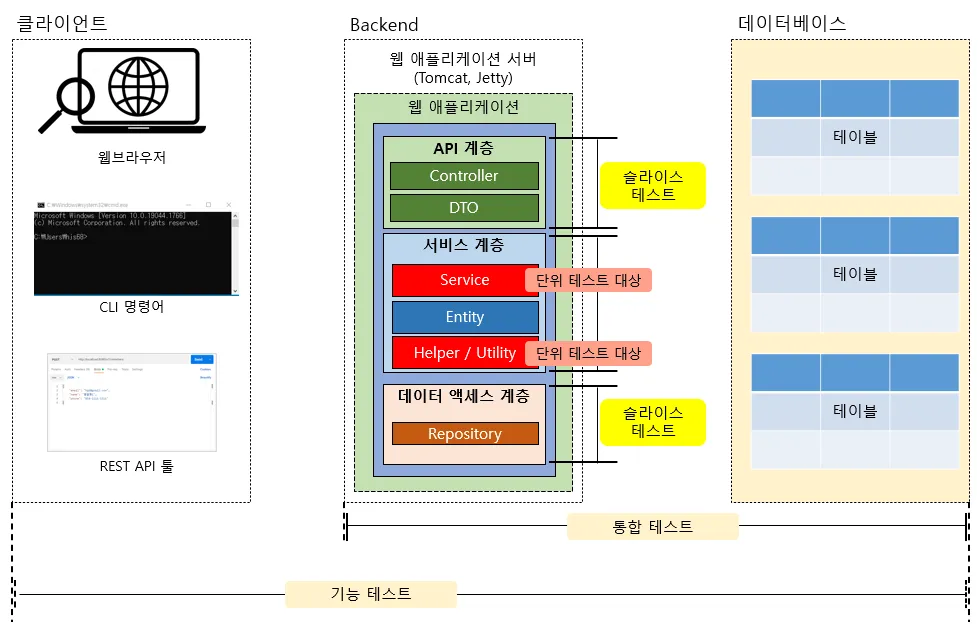
- A unit test
- about testing a specific, isolated part of the application.
- For example, in our coffee order sample app, the “unit” could be the service layer or utility classes used by the service layer
- The service layer contains the core business logic, which is usually the best target for unit testing because it can be tested independently.
- Layered Architecture: Service layer
- In practice, most unit tests are written at the method level.
- A test case
- A specification that defines the input data, execution conditions, and expected results for testing a unit such as a method. In short, it’s the test code you write to verify a single unit, containing the logic for inputs, conditions, and expected outcomes.
- Tests involving a database
- If a test interacts with a database but leaves the database state unchanged before and after the test, it can still be considered a unit test
- However, unit tests are ideally as independent and as small in scope as possible
Guidelines: F.I.R.S.T Principles
- Fast: Tests must run quickly to encourage frequent execution and early problem detection.
- Independent: Tests should run without influence from others; execution order must not affect results.
- Repeatable: Tests yield consistent results regardless of environment; avoid external dependencies.
- Self-validating: Tests automatically assert pass/fail without manual inspection.
- You shouldn’t have to inspect logs or manual outputs—the test itself should assert correctness automatically
- Timely: Tests are ideally written before or alongside feature implementation to ensure alignment with intended behavior.
- Even if you implement first, avoid writing tests long after the code is done—incrementally adding tests as you develop each part is more efficient
Example
public class Calculator {
    public int add(int a, int b) {
        return a + b;
    }
}

class CalculatorTest {

    @Test
    void testAdd() {
        Calculator calculator = new Calculator();
        int num1 = 3;
        int num2 = 5;
        int result = calculator.add(num1, num2);
        assertEquals(num1 + num2, result);  // 기대값과 실제값 비교
    }
}